Here I'm just going to put a heap of links and a few books and things I looked at in relation to this project. Not all of them I've actually used, but all were absorbed to some point when I skimmed through them. I'll keep adding to this list as I proceed
Japanese Tea Ceremony Related
http://www.shibuiswords.com/japantea.htm
http://www.teavana.com/tea-info/japanese-tea-ceremony
http://japanese-tea-ceremony.net/
http://en.wikipedia.org/wiki/Japanese_tea_ceremony
http://www.yuyu.co.nz/index.htm
http://voices.yahoo.com/various-foods-japanese-tea-ceremony-7426218.html
http://search.proquest.com/docview/212215652/13E061C0ACE1FE81703/1?accountid=40261
http://search.proquest.com/docview/421521861/13E061C0ACE1FE81703/2?accountid=40261
http://search.proquest.com/docview/405020053/13E061C0ACE1FE81703/3?accountid=40261
http://search.proquest.com/docview/348008464/13E061C0ACE1FE81703/4?accountid=40261
http://search.proquest.com/docview/388427225/13E061C0ACE1FE81703/6?accountid=40261
http://search.proquest.com/docview/413205399/13E061C0ACE1FE81703/8?accountid=40261
English Tea Ceremony Related
http://whatscookingamerica.net/History/HighTeaHistory.htm
http://coffeetea.about.com/od/historyculture/a/High-Tea-Vs-Afternoon-Tea.htm
http://www.wtea.com/about-tea_history.aspx
http://www3.hilton.com/resources/media/hi/CWLHITW/en_US/pdf/New_Afternoon_Tea.pdf
http://www.teageek.net/blog/?p=299
http://leafboxtea.com/496/understanding-anna/
http://en.wikipedia.org/wiki/Anna_Russell,_Duchess_of_Bedford
http://search.proquest.com/docview/394920145/13E00C2DA5E1D6EE105/1?accountid=40261
http://search.proquest.com/docview/759477507/13E01279B2852D14DE6/4?accountid=40261
http://search.proquest.com/docview/432930303/13E01279B2852D14DE6/3?accountid=40261
http://search.proquest.com/docview/320500289/13E01279B2852D14DE6/2?accountid=40261
http://search.proquest.com/docview/408595139/13E064E3F207465BD5/2?accountid=40261
http://search.proquest.com/docview/409394626/13E064E3F207465BD5/1?accountid=40261
http://search.proquest.com/docview/1349848808/13E064E3F207465BD5/6?accountid=40261
Misc
http://www.academia.edu/301880/Rituals_In_Organizations_A_Review_and_Expansion_of_Current_Theory
http://tulsagrad.ou.edu/japanresources/Japan%20Seminar%20Website%20Documents/Tea%20Ceremony.pdf
http://www.egs.edu/library/simone-de-beauvoir/biography/
http://www.theparisreview.org/interviews/4444/the-art-of-fiction-no-35-simone-de-beauvoir
http://www.brainyquote.com/quotes/authors/s/simone_de_beauvoir.html
http://www.marxists.org/reference/subject/ethics/de-beauvoir/
http://search.proquest.com/docview/900994490/13E00C223944E49FCBA/1?accountid=40261
Books:
Ellis, H. (2002) tea discovering, exploring, enjoying. Ryland Peters & Small, London
Goldsmith, S. (2006) tea. Reed Publishing, Auckland
Sunday, 26 May 2013

Project 3 - The Exotic is in the Ritual
I researched essays and theory works on rituals and ceremonies in culture, and found a piece by Gazi Islam and Michael J. Zyphur entitled "Rituals in Organizations, A Review and Expansion of Current Theory". The paper covered briefly some research that had already been done in the area, referenced other papers and people who I could look up for more information, and finished with the research by the authors.
Read the paper here
The piece that was of most interest to me was a section where a list of things that Moore and Myerhoff (1977) said had to be included for an action to become a ritual. (see page 120, para 4 of paper linked above)
I want to do rituals because they are the "exotic" within a culture familiar to us, and I want to compare two of the same rituals in different cultures to try to highlight this more.
Many people have afternoon tea, some with tea, some with coffee, some include food, others prefer to just have a glass of wine. But most people I've talked to don't really think of afternoon tea as any sort of ritual or ceremony, when you say "tea ceremony" people more often than not think of Japan or China. This idea that afternoon tea is not a ritual, whereas it rather is, is why it becomes exotic. To actually sit down and have a cup of tea, poured from a teapot sitting on the table, to have a tiered cake stand with small sweet pastries on, and to talk with those sitting with you at the table, it seems special, not like something we would do everyday, when we do, just not to that extent. We may sit down, prepare our tea in the kitchen and bring out a packet of shop bought biscuits while sitting around on couches yakking. The piece I want to design and create will show people that there is still that exciting sense of the exotic, of a ritual, in a plain afternoon 'cuppa' tea.
From the Japanese ceremony side it is a little bit different, because the ritual around tea isn't as exotic to those raised in Japanese culture, but it is exotic to us, raised in western society, by far more exotic, in some ways, as a british afternoon tea is. Though in some ways it is less exotic, because it is more well known as being exotic, that people become used to how different it is to our own culture.
By comparing the two cultures, I hope to bring about a more enhanced sense of exotic, for by looking at a ritual from a culture that is not one's own (this could be taken from either the British culture side or the Japanese culture side) people shall hopefully see the exotic in their own culture.
Read the paper here
The piece that was of most interest to me was a section where a list of things that Moore and Myerhoff (1977) said had to be included for an action to become a ritual. (see page 120, para 4 of paper linked above)
I want to do rituals because they are the "exotic" within a culture familiar to us, and I want to compare two of the same rituals in different cultures to try to highlight this more.
Many people have afternoon tea, some with tea, some with coffee, some include food, others prefer to just have a glass of wine. But most people I've talked to don't really think of afternoon tea as any sort of ritual or ceremony, when you say "tea ceremony" people more often than not think of Japan or China. This idea that afternoon tea is not a ritual, whereas it rather is, is why it becomes exotic. To actually sit down and have a cup of tea, poured from a teapot sitting on the table, to have a tiered cake stand with small sweet pastries on, and to talk with those sitting with you at the table, it seems special, not like something we would do everyday, when we do, just not to that extent. We may sit down, prepare our tea in the kitchen and bring out a packet of shop bought biscuits while sitting around on couches yakking. The piece I want to design and create will show people that there is still that exciting sense of the exotic, of a ritual, in a plain afternoon 'cuppa' tea.
From the Japanese ceremony side it is a little bit different, because the ritual around tea isn't as exotic to those raised in Japanese culture, but it is exotic to us, raised in western society, by far more exotic, in some ways, as a british afternoon tea is. Though in some ways it is less exotic, because it is more well known as being exotic, that people become used to how different it is to our own culture.
By comparing the two cultures, I hope to bring about a more enhanced sense of exotic, for by looking at a ritual from a culture that is not one's own (this could be taken from either the British culture side or the Japanese culture side) people shall hopefully see the exotic in their own culture.
Project 3 Research - Tea and Ceremony
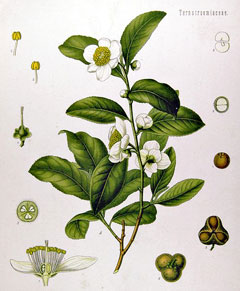 |
| Camellia Sinensis - Tea Plant. Image from http://www.pfaf.org/user/Plant.aspx?LatinName=Camellia+sinensis |
Tea is drunk throughout the world, in different forms and varieties. Tea as we, westerners, tend to know it is from a plant native to India - Camellia Sinensis.
Interestingly enough, green tea and black tea come from the same plant, they are just prepared differently.
The Japanese Tea Ceremony is a 400 year old tradition originally developed by wealthy merchants who followed the ways of Buddhism. Peace and harmony are created by the careful, smooth movements of the host - who prepares and serves the tea.
Originally it was a ritual that mainly men were interested in, but during the 19th century, when the Western cultures began to have some influence on Japanese culture, the ceremony became very popular amoung women too, and eventually it became a ritual that mainly women were hosts of.
Many people would not think of a british afternoon tea as a tea ceremony, but though it is not as rigidly structured as Japanese ceremonies tend to be, 'Low Tea' is still structured by custom and tradition. It is said that this modern form of afternoon tea was created by Duchess Anna of Bedford, when lighting in wealthy homes became more common, and residences started eating dinner later in the evening. Finding herself faint from hunger in the mid afternoon, the Duchess decided to have a gathering of friends during which food would be consumed and tea would be drunk during this mid afternoon. This light meal was eaten off a low table, similar to our coffee tables these days, and hence became known as Low Tea, as opposed to High Tea, which was the meal eaten by common folk during the late afternoon before it became dark.
Monday, 20 May 2013
Start of Project 3 - Back Into It
Right then, an update on the last few weeks:
I've been pretending to be on holiday, while doing alot of thinking about what to do in project three this term. At first I wanted to do something on light BDSM, as it's quite a misunderstood exotic culture to many people, but this proved to be difficult, as the concept behind the work I wanted to do was the female stepping out of the male gaze, and indeed taking on the power formally considered the masculine power, but the ways I could think of to present it would far too easily be mistaken for abuse, domestic and sexual. This is not something I want to portray in any light that is not strictly negative, so I intend on benching that project until I can find a way to portray it without people seeing it as a piece on abuse.
I started to think of how I had done my second project, as an installation rather than one or more pieces of work, and I enjoyed that, creating a set up, a scene, instead of just the one piece of work, and I want to do more of that.
So I started to look at the balance between the masculine and feminine, the male and the female, portrayed through an exotic scene or installation. At first I thought Classical Roman, as it is exotic, but still a part of western history, it is a representation of what we were, and the scene I would set up would be about how we are now - gaining equality, but what we have gained is still fragile in many places. I thought that perhaps a table setting, with the male/masculine place setting, and the female/feminine place setting, the male being strong, and sturdy, physically quite There, and stable. Whereas the female setting would be delicate and fragile, the chair perhaps made out of paper/cardboard, rather than sturdy wood.
This idea developed on to doing two tea settings, a masculine and feminine, but after talking with Kate, one of my tutors, I changed altogether, and started to focus on tea - more specifically, the rituals of tea in Western and Japanese culture, how they are different, and more importantly, the similarities. Though each of these rituals are exotic to each other, they have components that are the same.
I've been pretending to be on holiday, while doing alot of thinking about what to do in project three this term. At first I wanted to do something on light BDSM, as it's quite a misunderstood exotic culture to many people, but this proved to be difficult, as the concept behind the work I wanted to do was the female stepping out of the male gaze, and indeed taking on the power formally considered the masculine power, but the ways I could think of to present it would far too easily be mistaken for abuse, domestic and sexual. This is not something I want to portray in any light that is not strictly negative, so I intend on benching that project until I can find a way to portray it without people seeing it as a piece on abuse.
I started to think of how I had done my second project, as an installation rather than one or more pieces of work, and I enjoyed that, creating a set up, a scene, instead of just the one piece of work, and I want to do more of that.
So I started to look at the balance between the masculine and feminine, the male and the female, portrayed through an exotic scene or installation. At first I thought Classical Roman, as it is exotic, but still a part of western history, it is a representation of what we were, and the scene I would set up would be about how we are now - gaining equality, but what we have gained is still fragile in many places. I thought that perhaps a table setting, with the male/masculine place setting, and the female/feminine place setting, the male being strong, and sturdy, physically quite There, and stable. Whereas the female setting would be delicate and fragile, the chair perhaps made out of paper/cardboard, rather than sturdy wood.
This idea developed on to doing two tea settings, a masculine and feminine, but after talking with Kate, one of my tutors, I changed altogether, and started to focus on tea - more specifically, the rituals of tea in Western and Japanese culture, how they are different, and more importantly, the similarities. Though each of these rituals are exotic to each other, they have components that are the same.
Monday, 6 May 2013
Project Two - Contextual Statement?
I Still don't think I have this idea of a contextual statement right, but I've tried to create an image the will cry to convey the question, without using too many words


The words were meant to be a bit ambiguous, The question is really when will I become an artist, and not just a student, but I wanted to try leaving them so anyone who is trying to "become" something, whether and artist, a designer, a painter, a builder, a sports person - anything, can relate to the image.
I will try to create a more written contextual statement before the summative hand in date at the end of the semester, because I am simply not happy enough with either of these to hand them in for my final mark.
Update: I have made a new contextual based off some feed back I got back from the critique and from my tutors. This is purely written because I did not think I had any photos or images that really portrayed my concept very well. This written piece is entirely made up from questions, because my work is all about that question of identity, specifically the identity of a student artist who is trying to develop their identity as a full artist.
Contextual Statement:
When am I an artist, and not just someone who makes art?
When am I an artist, and not just a student?
Am I an artist? Was I an artist? Will I be an artist?
Have I always been an artist, is it a goal I must aim for?
When am I an artist?
Project two - Rough notes of development
These are rough notes I made as I was finding and developing my idea. They are not really intended for
other people to see, but they are important to how I find and develop my ideas when they are just beginning, so I want to put them on here anyway.
narrative - my story as a developing artist and student of nmit creative industries.
ball and chain bracelet - chained into limitations (stereo types, financial, etc)
series of charms (maybe copper and enamel?) with symbols of my "growth" and my identity
colour symbolisation - personal?
Level 4:
photoshop/graphic design
sound and moving image
object
image process
vis culture
drawing and design
Level 5:
drawing and design
vis culture
object design
sound and moving image
Level 6, semester 1:
Studio
Vis Culture
Professional practice
Develpoing as an artist - my identity:
(last year) object design/sound and moving image/
Object Desgin/Photography
When Am I An Artist?
badges
wise old owl?
fledgling, young, fully grown?
abstract, forming, formed
abstract idea, developing/forming knowledge, know/fully formed idea
yin yang fish
other people to see, but they are important to how I find and develop my ideas when they are just beginning, so I want to put them on here anyway.
narrative - my story as a developing artist and student of nmit creative industries.
ball and chain bracelet - chained into limitations (stereo types, financial, etc)
series of charms (maybe copper and enamel?) with symbols of my "growth" and my identity
colour symbolisation - personal?
Level 4:
photoshop/graphic design
sound and moving image
object
image process
vis culture
drawing and design
Level 5:
drawing and design
vis culture
object design
sound and moving image
Level 6, semester 1:
Studio
Vis Culture
Professional practice
Develpoing as an artist - my identity:
(last year) object design/sound and moving image/
Object Desgin/Photography
When Am I An Artist?
badges
wise old owl?
fledgling, young, fully grown?
abstract, forming, formed
abstract idea, developing/forming knowledge, know/fully formed idea
yin yang fish
Subscribe to:
Posts (Atom)